How TripSync turns a group of households into a trip that actually gets coordinated — without consensus theater, assumed yeses, or someone quietly getting steamrolled.
Most group-planning apps assume the group is one decider with extra opinions. You see this in the UX: someone proposes a thing, everyone votes yes/no, the majority wins, the minority deals with it. That model is fine for a board meeting. It's terrible for a trip with three families.
Trips don't run on majority rule. They run on coordination. "What are we doing tonight?" isn't a single question with a single answer. It's a stack of overlapping questions — one per household — and the right answer is often "different things, at the same time, by choice."
TripSync's primitive isn't the individual or the group. It's the household. A household is a small unit of people who already make decisions together — a family, a couple, a friend traveling solo. Each household joins a trip as a unit. Inside that unit, decisions are private. Across units, they're coordinated.
In a proposal-and-vote model, somebody has to do the work of framing the choice. "Should we do Mon Ami Gabi tonight?" The work of proposing creates friction; the act of voting creates pressure; the no-shows create resentment.
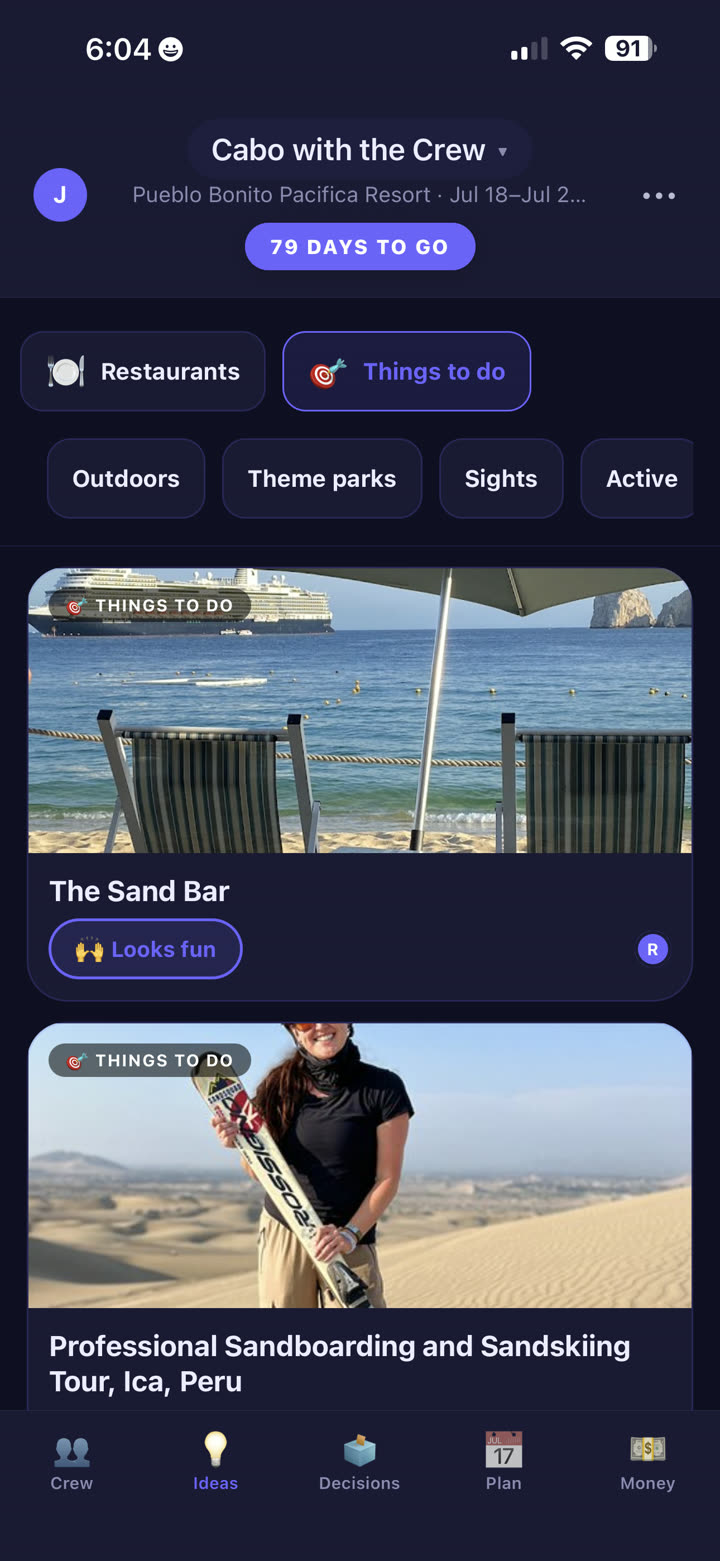
TripSync replaces the propose-and-vote loop with something lighter: reactions on interests. You see a restaurant or an activity that looks fun. You tap "Looks delicious" or "Looks fun" or "Looks amazing." That's not a vote. It's a signal. It costs nothing to send, nothing to receive.
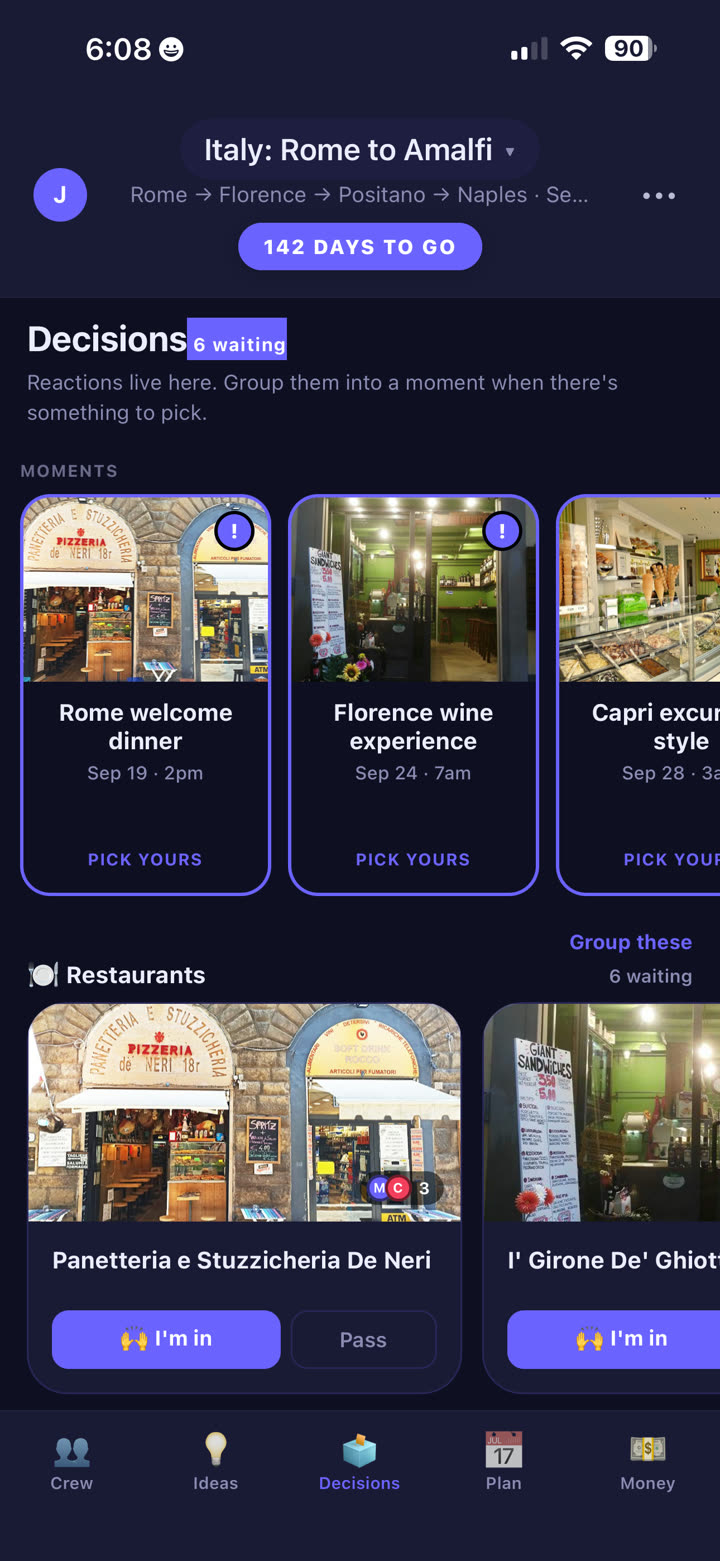
Reactions live in your Decisions queue — every member's "looks fun" list, but framed as the household's interest layer, not the group's. When a reaction has enough crew interest AND it makes sense to actually decide together, you bundle the interests into a moment: a time-bound thing where each household picks where they're going.
Interests are cheap. Moments are committed. The shape of the commitment matches the shape of the actual decision.
In group chat threads, silence usually gets assumed as a yes. "I sent the link, nobody objected, I booked it." That works until somebody who didn't read the message lands at the airport expecting a different plan.
TripSync inverts the default. If a moment has a deadline and you haven't picked, your pick is not assumed. The moment shows you as undecided. The crew sees who's still out. Light nudges fire before the deadline — at T-50%, T-20%, T-0 — to give the silent members a tap-sized opportunity to weigh in. No guilt-trip messages, no Reply-All ambiguity, just a nudge with the question and the options.
After the deadline, the picks stay editable. We learned the hard way that hard-locking a "decision" at the deadline creates more friction than it removes. Plans change. Moods change. TripSync treats the deadline as informational — by the time you'd actually need a hard lock (a reservation, a booking confirmation number), the crew has already converged.
Here's where most apps break: the case where the crew doesn't all want the same thing. Three families on a Vegas trip. Tonight is dinner. One household is going to Mon Ami Gabi. Another is going to In-N-Out. The third is at Topgolf. That's not a decision-making failure — that's a coordinated split, and it's completely normal.
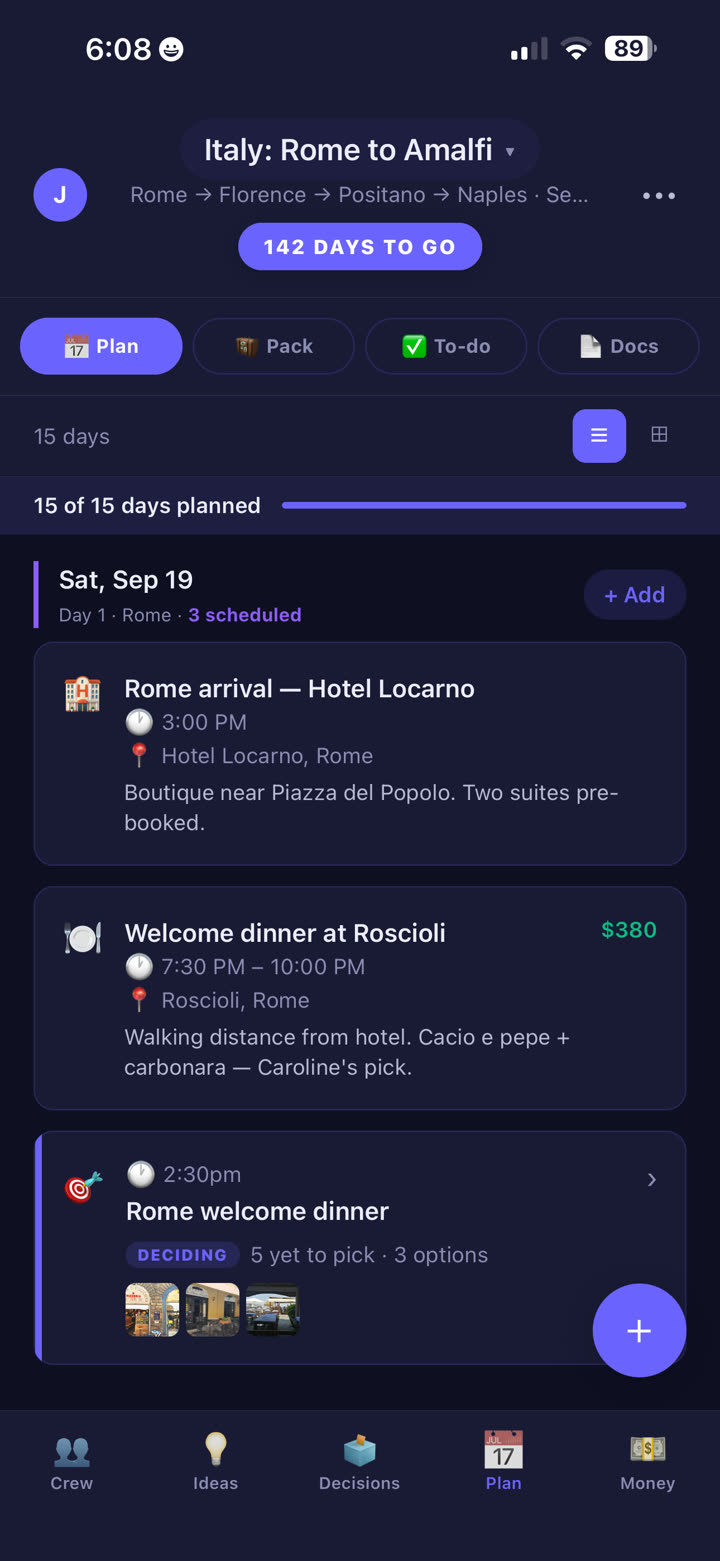
In TripSync, a moment that splits doesn't read as broken consensus. It reads as three sub-events of the same time slot, side by side. The Plan tab renders them in chronological order with state-aware accents — gold for "still deciding," purple for "split," green for "everyone's aligned." A passing glance tells you who's where without anyone having to ask.
Treating each household as its own unit pays off here too. Some families travel as one — the kids stay with the parents the whole trip. Others split mid-trip: adults grab a quiet dinner while a sitter takes the kids back to the hotel. TripSync handles both, without making either feel like the exception.
Every expense is logged with a scope: just me, my household, the whole crew, or a specific sub-group. The math follows the scope automatically. If our family ate at Mon Ami Gabi with the Smiths, that's a four-way split between two households, not a six-way split across the whole crew.
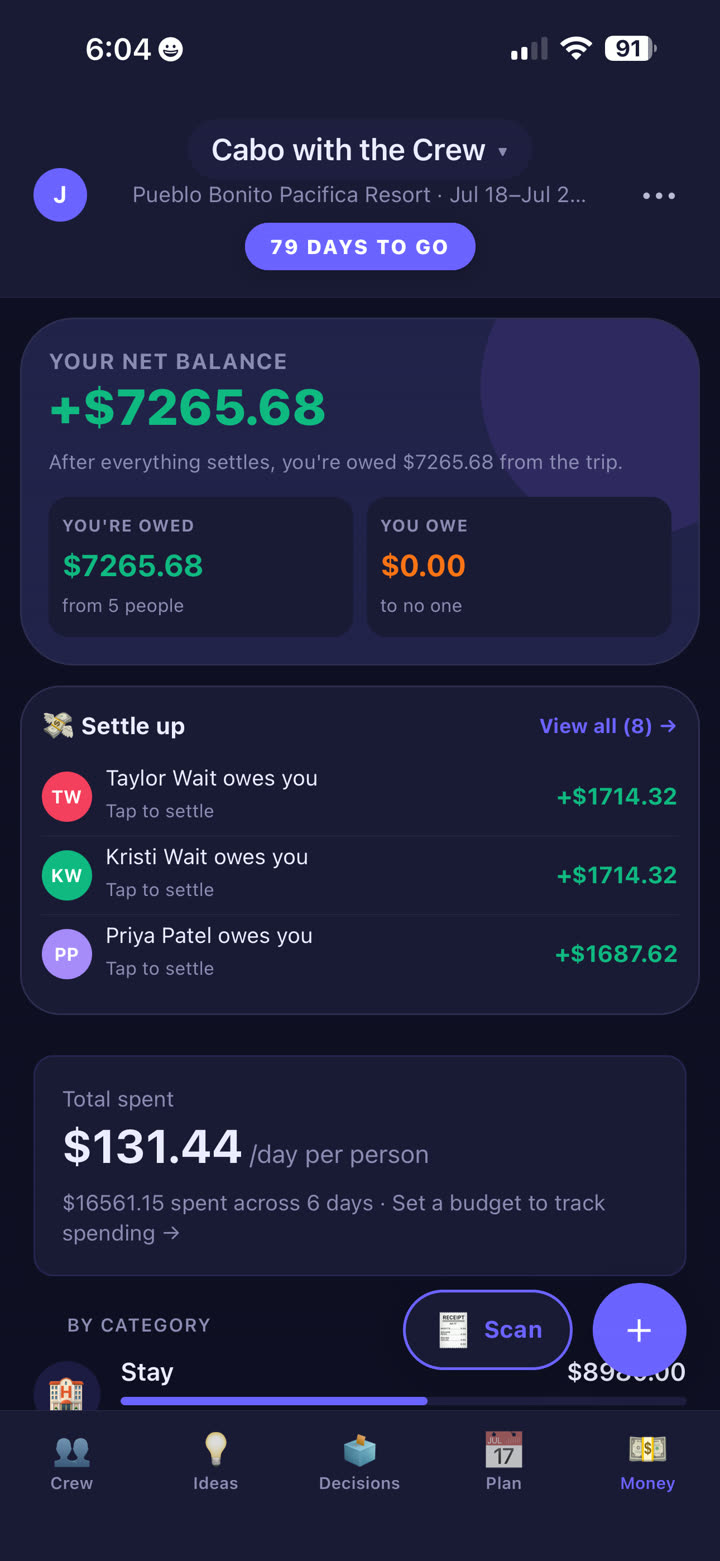
The Money tab shows your net balance at the top — what you owe and what you're owed — and a settle-up sheet handles the rest with Venmo deeplinks for the most common case. We deliberately don't force settlement until the trip is over. Most groups don't actually settle until they're home.
The Household Interest Model emerged from real trips with real crews — not from a whiteboard exercise. It works because it matches the actual social structure of group travel:
The output of a trip planned in TripSync isn't "everyone agreed on everything." It's "every household knew what was happening, picked what they were in for, and trusted the rest to do the same." That's a different shape of agreement — and it's the shape group trips actually need.
The thesis is fine on a page. It clicks when you actually use it with a crew. Free to download.
 TripSync